Chinese (Simplified)
 Arabic
 Dutch
Dutch English
 French
 German
 Italian
 Portuguese
 Russian
 Spanish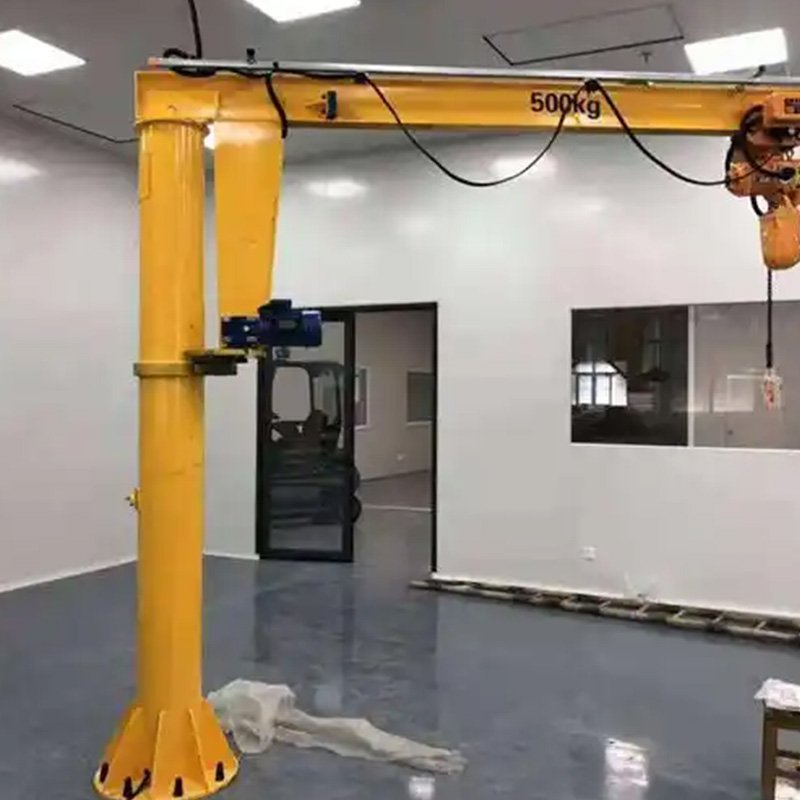
In modern industrial and manufacturing sectors, efficient material handling and precise lifting are crucial for productivity. Compared to large fixed cranes, the portable jib crane has gained widespread use in small-to-medium-sized workshops, maintenance stations, and warehouses, due to its flexibility and cost-effectiveness.
It helps operators perform efficient and safe material handling within limited spaces, making it an essential part of modern light lifting systems.
1. What Is a Portable Jib Crane?
A portable jib crane is a compact and mobile lifting device, typically consisting of a base, mast, jib arm, hoist trolley, and lifting mechanism. According to OSHA 1910.179 on crane safety, it falls under the category of “jib-type cranes,” primarily used for lifting and handling operations in localized areas.
Unlike fixed jib cranes, a movable base or caster wheels equip portable jib cranes, enabling operators to move them between different workstations to meet flexible operational requirements. The lifting capacity typically ranges from 0.25 tons to 2 tons, making them ideal for single-person operations or small production lines.
2. Key Components
Here’s a table outlining the main components of a portable jib crane and their functions:
| Component | Function | Technical Notes |
|---|---|---|
| Base / Base Plate | Provides stable support for the crane, available as fixed or with wheels for mobility | Ensures stability and prevents tipping |
| Mast (Column) | Connects the base and the jib arm, supporting the primary load | Usually made of thick steel pipes or I-beams |
| Jib Arm | Responsible for horizontal rotation and suspension of loads | Can rotate 360° or set at a fixed angle |
| Hoist & Trolley | Lifts the load vertically and moves it horizontally | Can be manually, electrically, or pneumatically driven |
| Wheels / Casters | Allows for crane mobility and positioning | Often equipped with lock features to prevent movement during operation |
3. How Does a Portable Jib Crane Work?
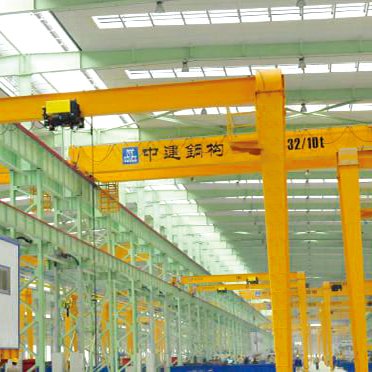
The operation of a portable jib crane is based on leverage and rotational mechanics. The jib arm is connected to the mast through bearings, forming a rotating structure. The hoist trolley moves along the jib arm to adjust the horizontal position of the load.
When the hoist system is activated, the motor drives the wire rope to lift the load vertically. The jib arm then rotates, and the trolley moves the load to the target location. Some modern portable jib cranes use frequency drive technology and electronic brake systems to make operations smoother and safer (source: CMAA – Crane Manufacturers Association of America).
4. Common Types of Portable Jib Cranes
Portable jib cranes come in several variations based on their design and application. Below are some common types:
- Mobile Floor-Mounted Type: Mounted on wheels, allowing the crane to move between different workstations.
- Wall-Traveling Type: Moves along walls or rails, ideal for assembly lines.
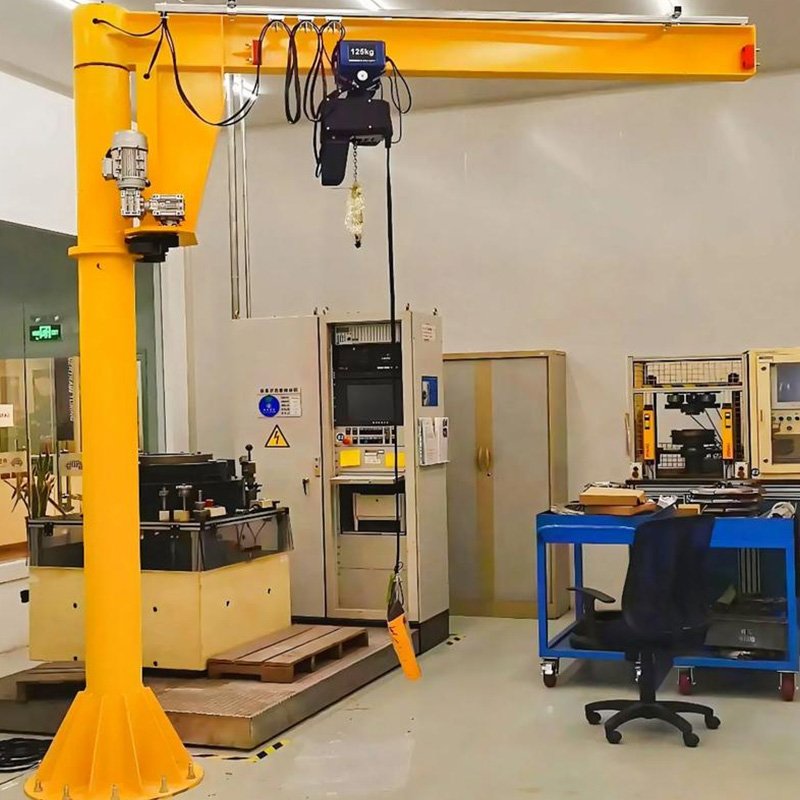
- Lightweight Aluminum Type: Lighter, corrosion-resistant cranes often used in laboratories or cleanrooms.
- Adjustable Height Type: Designed to accommodate lifting requirements at different heights.
5. Typical Applications
Due to its compact structure and flexibility, a portable jib crane is widely used in the following areas:
- Small assembly lines or maintenance stations
- Automotive manufacturing and equipment maintenance workshops
- Warehouses and logistics centers
- Temporary lifting operations on construction sites
6. Advantages of Using a Portable Jib Crane
| Advantage | Explanation |
|---|---|
| Flexible Mobility | Can be moved between different work areas, saving time on workspace setup. |
| Easy Installation | No need for fixed foundations; ready to use upon installation. |
| Lower Cost | More cost-effective than larger overhead or gantry cranes. |
| Safe Operation | Equipped with anti-slip wheels and overload protection for increased safety. |
| Adaptable to Various Scenarios | Ideal for temporary or space-restricted lifting tasks. |
7. Maintenance and Safety Standards
To ensure the long-term reliable performance of a portable jib crane, regular inspections and maintenance are required:
- Daily checks for wear on wire ropes, hooks, and rotating bearings
- Periodic lubrication of rotating parts on the jib arm and mast connections
- Pre-use inspection of the caster locking mechanisms
- Annual load testing and maintenance record-keeping
These maintenance requirements are based on OSHA 1910.179 – Overhead and Gantry Cranes Safety Regulations.
8. Conclusion
By now, you should have a clear understanding of what a portable jib crane is and how it operates. With its compact design, flexibility, and safety features, it has become an efficient lifting solution in modern industries.
Yonghao Crane has over ten years of industry experience, providing complete solutions from crane design and manufacturing to installation and maintenance. We offer customized lifting systems, including portable jib cranes, that comply with international standards and ISO safety regulations.
To learn more about technical specifications and customization options, feel free to contact our technical team at yonghaoqizhong@163.com for professional support.